Showing posts with label solar activity. Show all posts

Monday, 5 August 2013

radio thunderstorms

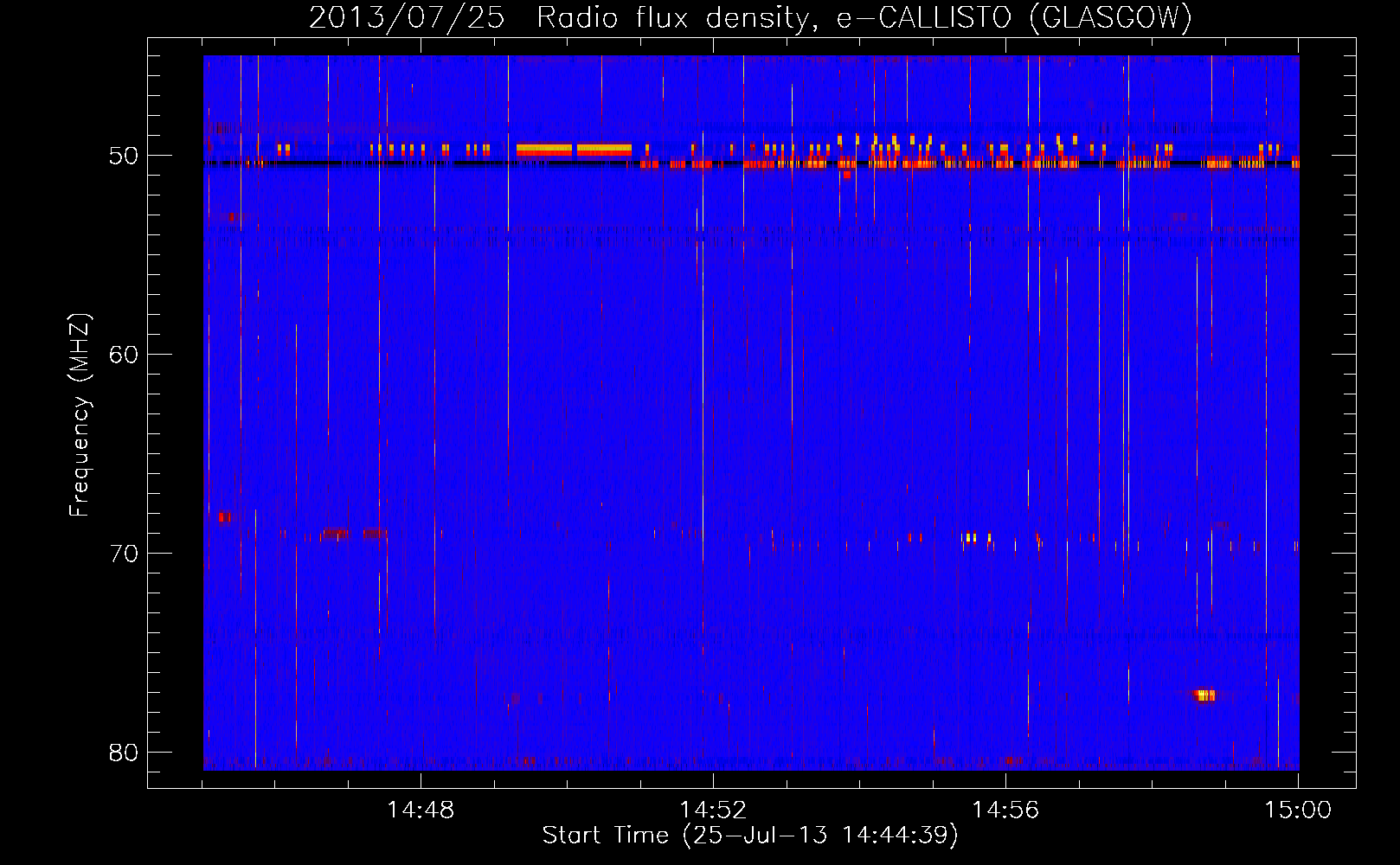
In Scotland we've just had the second hottest summer on record. As the month wore on more and more cloud accompanied those high temperatures and July closed with some beautiful thunderstorms. I was tickled to see them showing up in the measurements from our little Callisto radio telescope, mentioned in an earlier post, e.g.: dynamic spectrogram, 25 July 2013, 14.45, showing lightning

This picture is called a spectrogram. What's it showing? Time increases from left to right, across the picture. The caption at the top tells us that the picture represents events on 25 July, 2013. At the bottom of the picture you can read that the picture starts at 14.45, quarter to three in the afternoon, and that it represents about a quarter of an hour's worth of data, i.e. of measurements of the radio signals arriving at the antenna out at Acre Road.

Each of those vertical streaks is the pulse of radio waves from a bolt of lightning. You've heard the radio when there is lightning, that loud "click". Draw a horizontal line across the picture and each time it crosses one of those vertical lines, that's a lightning strike; a "click" if you're feeding the radio waves to a loudspeaker. For example there was a bolt of lightning just before 14.52. I should emphasise that this is the pulse of radio waves from the lightning strike arriving at the antenna; the lightning itself might be some miles away.

The height at which that horizontal line is placed represents the frequency of the radio waves. For older readers (like myself), we can think of where we stop moving the dial that tunes the radio to a particular station, perhaps the Home Service or the Light Programme, or one of the many more distant and exotic possibilities: Radio Luxembourg, Hilversum , Athlone....

You can read the frequency of the radio waves from the scale at the right-hand side. They lie between 45 and 80 MHz ("megahertz" - Mega, millions, of Hertz, cycles per second). This is quite a nice range: Medium Wave radio stations mostly transmit between 0.1 and 2 MHz, while FM radio stations are mostly between about 85 and 110 MHz. So this range is away from strong, man-made signals and that's why we use it. Across the top of the picture there's a funny, repeating pattern and that's some sort of man-made radio signal, possibly from some sort of electrical machinery rather than a deliberate transmission.

The colours represent how intense the radio waves are (how loud the click would be if we played them through a loudspeaker), at each time and frequency. The blue colour that's mostly there in the background means nothing much is going on. The most intense radio waves are yellow. Looking at that lightning "click" just before 14:52, for instance, it would have been a much quieter click if we had tuned the dial to below 50 MHz or above about 75 MHz, than in between these frequencies.

When I saw this lightning signal it reminded me of the very beginnings of radio astronomy, in 1932 and 1933. Bell Labs wanted to start using radio frequencies of 10s of MHz for communication, but they needed to know what competition radio transmissions would face from natural sources. Karl Jansky, a young physics graduate, was tasked with answering this question. He discovered three natural sources of radio waves at these frequencies. The first is the one we've seen here: nearby thunderstorms, highly variable, intense but short-lived. The second was the weaker, steadier signal from more distant thunderstorms; there's usually thunder happening somewhere. The third, a steady "hiss", was a much more unexpected discovery. Jansky was able to work out that this came from the sky, from a direction that stayed fixed among the stars and seemed to coincide with the direction to the centre of the Milky Way. "Star static," he called it. This was the first indication that radio waves could tell us something about the universe beyond Earth, although there was only slow progress at first in following up this discovery. Now, of course, radio astronomy is a major branch of the subject. The information it has given us on, e.g. cool gas in interstellar space, neutron stars, or supermassive black holes in other galaxies, could not have been obtained in any other way. The radio wavelengths still have a major role to play in answering the big, fundamental questions of Astronomy, so bigger and more powerful telescopes are still being built, like LOFAR.

Our Callisto receiver's antenna is too wee to detect most cosmic sources but it does pick up what it's meant to: the bursts of intense radio waves that sometimes come from the Sun when there are sunspots, flares etc. These were discovered in February 1942 by J S Hey, an English physicist working on radar during World War II. He soon recognised that this new sort of signal was coming from the Sun, not a German radar jamming technology at all. Jansky would have discovered these solar radio bursts if he hadn't been working at the bottom of the sunspot cycle, when the Sun was not very active at all.

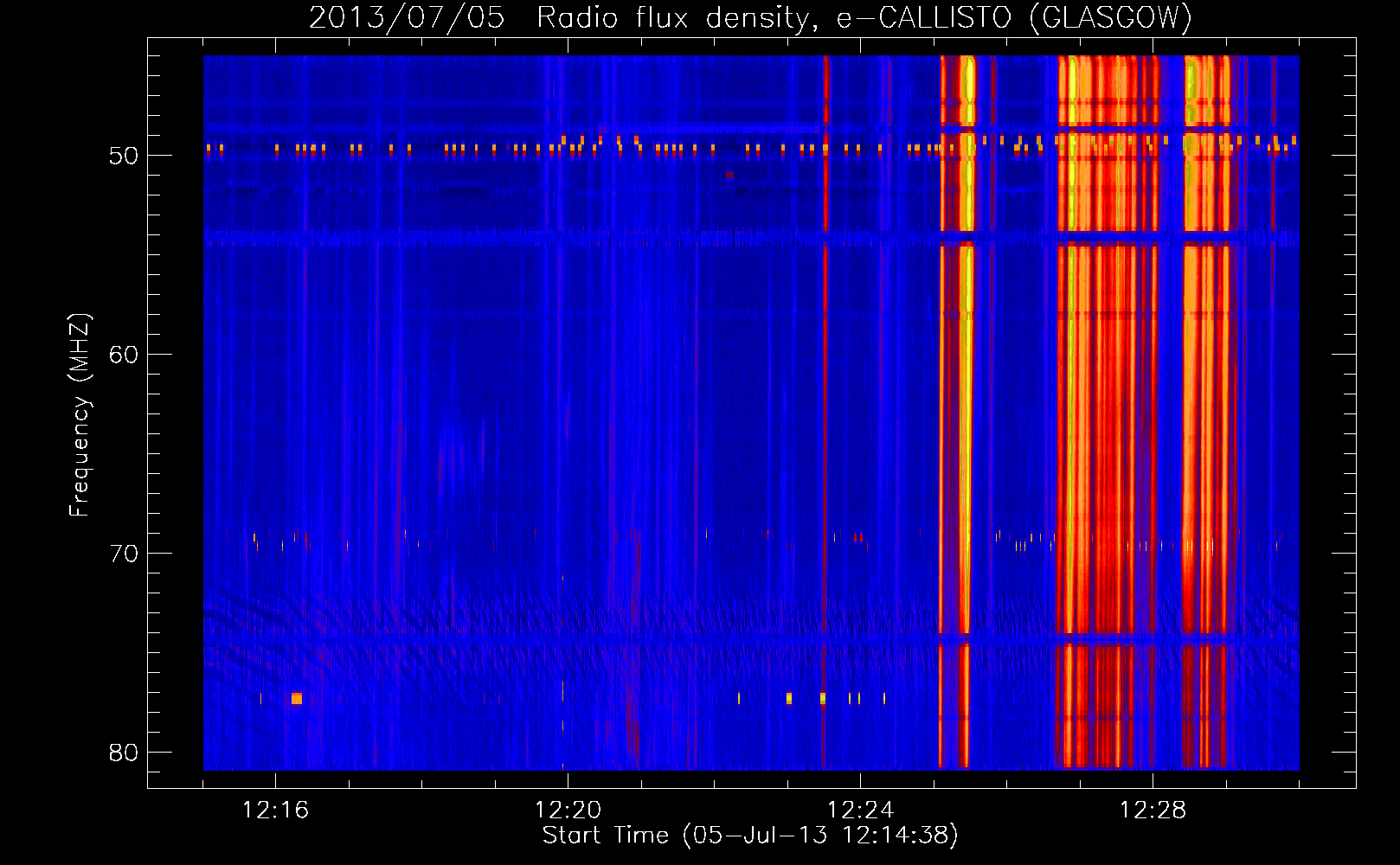
Now that we can understand spectrograms, here's a wee sample, from earlier in July on a day the Sun was particularly busy. dynamic spectrogram, 5 July 2013, 12.15, with several solar radio bursts Just one comment just now: the solar radio bursts might look a little bit like very intense versions of the signals we get from thunderstorms on Earth. They're not! They're something quite different that can only happen in the tenuous, high temperature gas of the Sun's outer atmosphere. More in a future blog post.
Lastly, here's a nice lightning photo also from July 2103:

SZ0796 : Northbourne: lightning continues by Chris Downer
Northbourne: lightning continues
  © Copyright Chris Downer and licensed for reuse under this Creative Commons Licence.

Wednesday, 17 October 2012

Phew

busy, busy weeks. Seven hours of teaching per week, all squeezed into a 26 hour period that starts at 19.30 on a Wednesday. Two more hours will be added soon (I know, from outside academia seven hours may not sound like a lot, but each hour of face to face contact needs more hours of preparation). Also:
  • a school pupil spent a week doing work experience with me. Very rewarding for me, I think new and exciting for her
  • we had our first Cosmic Way public event, a mix of cosmic ray and subatomic physics, solar-terrestrial interactions, and Scottish science history, hopefully made accessible for all sorts of people. Watch that website, by the way - more to come. Special mention for the music by Drew Mulholland.
  • we were visited by Christian Monstein, from ETH Zurich, who helped us to establish a wee radio telescope looking for bursts of radio waves from the Sun. Our telescope uses Christian's Callisto receiver, and contributes its data to the e-Callisto network. Here's our first solar radio burst - doesn't look like much, I know - we'll open it up in other blog postings. Here is Christian's report of its setting-up
  • the Centre for Open Studies had its official launch event, a very nice day with taster sessions on many of our subjects (yes, including Astronomy), and with representatives from many of friends in other organisations, like the Astronomical Society of Glasgow
  • I took a couple of posters to the Royal Astronomical Society discussion meeting on solar radiophysics, one on our e-Callisto node and the other on the work Aline Dinkelaker and I carried out together, asking: "do solar flares behave like avalanches or cascades?"
And of course all the other jobs that go with the start of the teaching year and with keeping the research going, some just as interesting as those I've listed. Too much blogging - back to work.

Monday, 21 May 2012

May 21: pub!

It's 21 May, a very significant date. In my PhD thesis I analysed X-ray data from three solar flares, on 10 April, 21 May and 5 November 1980. The data had been collected by the Hard X-ray Imaging Spectrometer (HXIS) on the SMM satellite.
NASA SDO image of solar magnetic loops
At that time we believed that hard (penetrating) X-rays from the Sun would come from the ends of magnetic loops (like those shown in the accompanying picture of the Sun in ultraviolet light), where they meet the dense solar atmosphere. HXIS showed us for the first time where on the Sun the hard X-rays were coming from. Sure enough these three flares displayed X-rays coming from pairs of points on the Sun, presumably the two end points of the loops involved: "footpoints". It would have been a big surprise if X-rays had come from above the surface - although in due course this too was seen. In Glasgow we weren't the first people to look at these footpoint observations but we tried to see what more they could tell us about the workings of flares.

The 21 May flare was one of the most intensively studied at that time. It was a big (X-class) flare, it did lots of different, interesting things and was inspected by several leading edge instruments, like HXIS. So many people wrote articles on aspects of this flare that it eventually played the starring role in its very own review article, where two famous solar astronomers summarised the various studies and drew them all together.

Many individual solar flares have been important in our developing understanding of these events: the first big flare seen in some new instrument, a flare that did something in a particularly simple way so that cause and effect seem clearer than in most cases, a flare that did something dramatic never seen before.

Over the decades there have been many such significant events. This was useful when I was young and frivolous. Today, for example, we could say, "it's the anniversary of the 21 May 1980 flare. We need to celebrate this - let's go to the pub!" In fact, if we scoured the solar physics literature we could probably find a solar flare to celebrate on most days of the calendar, especially now a couple of decades on: 13 January, 20 January, 23 February, 24 May, 3 June, 7 June, 14 July, 28 October....that's enough, you get the point, and I'm sorry so few of them have nice web resources and so many of the links are technical. Maybe that should be a wee job for somebody: "Flare of the day" blog. Anyway we never needed to wait very long to have an excuse for a wee pub visit, and if we really needed an excuse we could probably scour the literature and find somebody with their own wee solar observatory, lost and forgotten in the woods or clinging to some unvisited mountainside in some far-off and exotic land, who had observed a flare on that particular date.

Anyway, nowadays those pub visits are much rarer. We probably only used a famous solar flare as an excuse on a few occasions, to be honest - most of the time we didn't worry about excuses. But as I headed home on the bus this beautiful May day, I spotted lots of people sitting outside enjoying a beer or a glass of wine and I was glad to see that the X-class footpoint flare of 21 May 1980 is still celebrated vigorously.

Image: NASA Solar Dynamics Observatory AIA instrument ultraviolet image of solar loops from January 2012

Saturday, 12 May 2012

Beyond the End of the World

I'm a sucker for the movies of Werner Herzog. I love his tales of overweening ambition, of people driven to places they shouldn't go, of characters who will never fit in. I'm hypnotised by Aguirre's awful thrust for Eldorado, though boats cling mysteriously to the treetops and his brutalised followers are cut down by attackers so implacable and faceless we can't even call them enemies. We know he can only finish up alone on the raft with the monkeys but that somehow makes his raging insanity all the more beautiful. Wisconsin is just as strange and hostile a destination for the hapless Stroszek ("one of the strangest films ever made"). The - comparatively - charming Fitzcarraldo drags a steamboat over a mountain to become a rubber magnate solely so that he can bring live opera to the jungle.

It makes complete sense that Herzog should turn his attention equally to real-life examples of such ambition: the man who dreams of floating above the canopy of the rainforest, the man who lived among grizzly bears, the people seeking secrets of the planet and of the universe in the Antarctic. He can't resist those characters whose ambitions take them places you shouldn't go, where the possibility of death is never far away or where the human body really cannot survive unaided. They're nicer people than Aguirre, usually cannier too, but restless dreamers nonetheless.

I haven't seen his science fiction movie, Wild Blue Yonder but there had to be one. Most of the Universe is much more hostile even than Antarctica and the exploration of outer space is one of the hugest of Herzogian projects. On Mars, for instance, there are landscapes and sights as strange as anything even in Fata Morgana: the huge dust devils, for instance, or the pink, streaked sand dunes of the polar regions.

In the solar physics community we're excited that ESA have at last given the Solar Orbiter mission the go-ahead. In the UK we're happy that it will be built here.

Mercury is the planet nearest to the Sun. On the day side of Mercury it's hot enough to melt lead. Solar Orbiter will go closer to the Sun than Mercury, and closer than any previous spacecraft. At its closest the Sun will be almost 13 times brighter than it is here on Earth. Heat poses a major challenge to the engineers so Solar Orbiter's instruments will peek at the Sun through holes in a heat shield, designed to keep the rest of the spacecraft at a stable temperature. The instruments will be pointing at the Sun so they themselves will have to cope with the intense sunlight, as will the solar panels that will provide electricity.

Solar Orbiter is venturing into a region of the solar system unexplored since the 1970s. Radiation (cosmic rays) accompanies the disturbances that travel away from the Sun, and is also produced at the Sun during solar flares. The level of radiation inside Mercury's orbit is uncertain but it will certainly be greater than here at Earth and the electronics will have to keep functioning in spite of this. The very phenomena Solar Orbiter aims to study will also make life difficult for it.

Solar Orbiter will be designed and built to meet these challenging conditions but it is exploring a distant, alien region of space: a dangerous place. Lots of brainpower and planning, as well as hundreds of millions of Euros, will be spent building, launching and operating it. Nobody's physical life will be in danger and it will be planned and operated cannily, without hubris. Solar Orbiter will not spin off out of the solar system, alone with the space monkeys. Nonetheless the allure of this dangerous, unexplored region of space makes me think of these crazy dreamers of the Herzog movies. And maybe there's a little of that crazy lust for dangerous places somewhere in the mind of even the soberest of space scientists.

Sunday, 6 February 2011

all round the Sun

it seems to me that vague feelings about the world and how it works become more firmly held and acted on as one gets older. So I find myself at last turning into a Guardian reader. It has to be admitted there are many sorts of entertainment on the Guardian's website particularly, such as today's article on Isabella Rossellini's series of animal sex short films. Also catching my more professional eye is this item on the first 360° view of the Sun's surface. Will we learn something uniquely new form this? Of course not: no dragons or UFO's or day-glo sunspots have been lurking in the unseen parts of the Sun's surface, always furtively avoiding our cameras and telescopes. It's a symbolic moment, a point where our monitoring of the Sun and its outputs can attain a new level of sophistication; a small step for routine science, the kind that eventually and unspectacularly leads to changes in thinking. It's certainly a media friendly step, however, even if there is no media-friendly huge new discovery,and the Guardian's article is only one of many all over the internet. That incremental process will lead to new things - or not - in its own sweet time, and in the meantime everybody can enjoy the continually improving view of our nearest star.